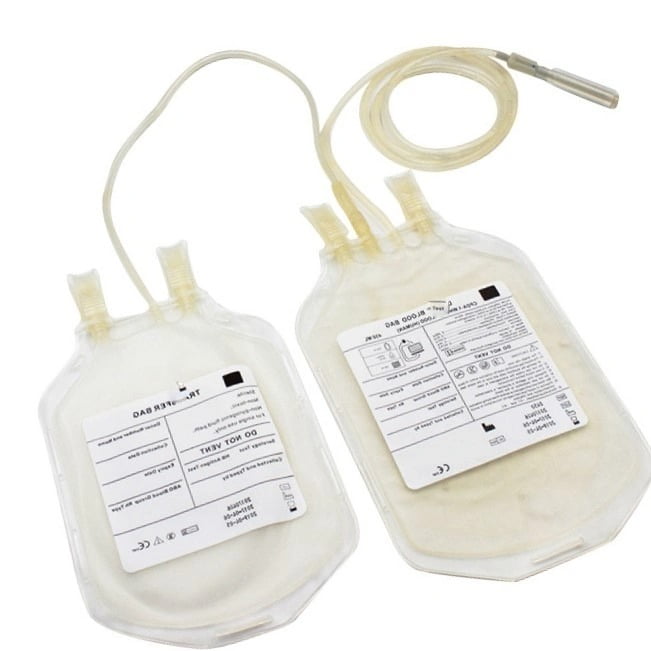
| Product Name | Blood Bag |
| Main Material | PVC |
| OEM/ODM | Yes |
| Certificate | CE, ISO13485, ISO9001 |
| Usage | Hospital |
| Sterile | EO sterilization |
| Sample | Free |
| Service | In the groups we serve: distributors, import traders, government procurement, buying agents, and medical chain stores, we provide one-stop procurement for you to simplify your procurement process. |
A Disposable Sterile Blood Bag is a medical product designed for blood collection and related blood handling procedures. It provides a sterile container system for hospitals, blood banks, transfusion centers, and other healthcare facilities involved in blood collection and blood component management.
Blood bag systems play an important role in the transfusion supply chain. Depending on their configuration, they can support whole blood collection, component separation, transfer, and storage according to established medical procedures.
Disposable sterile blood bags are commonly classified into four configurations: single, double, triple, and quadruple. These systems differ in the number of connected containers and the arrangements available for blood handling.
A single system generally consists of one primary bag, while double, triple, and quadruple systems incorporate additional satellite bags. The appropriate configuration depends on the intended application, component processing requirements, and institutional procedures.
For hospitals and blood banks, selecting a suitable blood bag involves more than comparing the number of connected containers. Buyers should also evaluate the intended use, anticoagulant requirements, product documentation, and compatibility with established collection and processing procedures.
Siny Medical supplies blood collection products for hospitals, blood banks, transfusion centers, and international medical distributors. We support professional buyers with product information and bulk purchasing coordination.
Disposable sterile blood bags are intended for single-use medical applications and are supplied in a sterile condition.
These two characteristics serve different purposes:
For healthcare facilities, both characteristics are important when selecting blood collection supplies. Buyers should review the applicable product documentation and instructions for use to understand the intended application, handling requirements, and storage conditions.
During use, healthcare personnel should follow established procedures for checking, handling, and operating the selected system. After use, the blood bag and associated components should be managed according to institutional medical waste procedures and applicable regulations.
A single blood bag generally consists of one primary collection container without additional connected satellite bags.
Its straightforward arrangement is suitable for workflows requiring one main container.
When evaluating a single system, procurement teams should consider the intended collection procedure and whether additional containers are needed for subsequent component transfer.
A double blood bag generally consists of one primary bag and one connected satellite bag.
The primary bag serves as the main collection container, while the satellite bag provides an additional container for subsequent blood handling and component transfer.
Compared with a single configuration, the double system offers another connected container.
Its suitability depends on the intended processing procedure and the function required from the satellite bag.
A triple blood bag generally consists of one primary bag and two connected satellite bags.
The additional containers provide more options for workflows involving multiple component transfer stages.
Depending on the system design and processing procedures, triple configurations may support the handling of different blood components following whole blood collection.
The actual function of each connected bag should be confirmed through the technical documentation of the selected system.
A quadruple blood bag generally consists of one primary bag and three connected satellite bags.
Among these four common configurations, it provides the greatest number of connected containers.
This arrangement may be appropriate for workflows requiring several connected containers during blood component processing and transfer.
However, a quadruple system is not automatically the best choice for every facility. The appropriate configuration depends on the intended workflow and the number of containers actually required.
| Configuration | General Structure | Main Selection Consideration |
|---|---|---|
| Single | 1 primary bag | One-container collection |
| Double | 1 primary + 1 satellite | Additional transfer container |
| Triple | 1 primary + 2 satellites | Multiple transfer containers |
| Quadruple | 1 primary + 3 satellites | More extensive component handling |
These descriptions explain common industry configurations. The actual functions and suitability of each system depend on its design, intended application, and applicable instructions.
Anticoagulant and additive solutions are important considerations when selecting blood collection systems. However, they serve different functions and should not be treated as interchangeable.
CPD (Citrate Phosphate Dextrose)
CPD contains citrate, phosphate, and dextrose. Citrate helps prevent coagulation by binding calcium, phosphate contributes to the buffering environment, and dextrose provides a metabolic energy source.
CPDA-1 (Citrate Phosphate Dextrose Adenine)
CPDA-1 contains citrate, phosphate, dextrose, and adenine. Adenine supports red blood cell energy metabolism during storage.
SAGM (Saline-Adenine-Glucose-Mannitol)
SAGM is an additive solution associated with red blood cell processing and storage. It is used in certain blood processing systems together with an appropriate collection and anticoagulant arrangement.
For procurement teams, the distinction between anticoagulant-preservative solutions and additive solutions is important when reviewing product configurations.
The appropriate formulation depends on the intended collection, processing, and storage procedures. The discussion above represents general industry knowledge and does not confirm that any particular formulation is included in this product. Buyers should verify the actual configuration through the applicable product documentation.
Blood collection is an important stage in transfusion services. After collection, whole blood may undergo further processing to separate different components.
Depending on the processing method, these components may include:
Connected satellite bags provide additional containers for component transfer within suitable blood bag systems.
However, the number of connected bags alone does not determine which components can be prepared. The selected system, processing equipment, and established procedures all influence the final workflow.
Hospital blood collection departments require appropriate medical products for blood collection and related handling procedures.
Disposable sterile blood bags provide containers for applicable collection workflows.
The choice between single, double, triple, and quadruple configurations depends on the number of connected containers required by the intended procedure.
For procurement teams, identifying these requirements before ordering helps prevent configuration mismatches and unnecessary purchasing costs.
Hospital transfusion departments coordinate blood component management and transfusion-related operations.
They work with blood banks, laboratories, and healthcare professionals to manage the supply and use of blood components.
Different blood bag configurations may be relevant to different stages of these workflows.
Hospitals should evaluate their operational requirements and confirm that the selected blood bag system is appropriate for its intended application.
Blood banks and collection centers are major users of disposable sterile blood bag systems.
Their operations may involve whole blood collection, component separation, storage, and distribution.
Different configurations provide different arrangements for handling collected blood and separated components.
When purchasing, blood banks should consider their collection procedures, processing equipment, anticoagulant requirements, and intended component preparation workflows.
Blood component processing facilities use specialized procedures to separate and prepare different blood components.
Their operations may involve red blood cell preparation, plasma separation, platelet processing, and component transfer.
The selected blood bag configuration should match the intended processing method and the facility’s equipment.
Procurement teams should consult the applicable technical documentation before selecting a system for a particular processing application.
Medical distributors supply blood collection products to hospitals, blood banks, transfusion centers, and other healthcare institutions.
For distributors, understanding disposable sterile blood bag configurations is important when organizing product catalogs.
Products can be classified according to their number of connected bags and relevant product characteristics.
Clear product descriptions help distributors prepare quotations, respond to customer inquiries, manage inventory, and coordinate repeat orders.
The first step is to identify the required product characteristics.
For this product category, buyers should confirm that they need disposable sterile blood bags rather than reusable containers or products intended for different medical applications.
They should also review the applicable documentation to confirm the sterile status, intended use, and handling instructions.
This helps purchasing teams establish clear requirements before comparing different configurations.
The number of connected bags is an important selection factor.
A single system provides one primary container, while double, triple, and quadruple systems incorporate additional satellite bags.
When evaluating these options, procurement teams should consider:
Selecting a configuration according to actual operational needs helps prevent unnecessary complexity and purchasing mismatches.
Anticoagulant and additive solutions should be evaluated separately.
CPD and CPDA-1 are anticoagulant-preservative formulations, while SAGM is an additive solution associated with red blood cell processing and storage.
Before purchasing, buyers should identify the required formulation and confirm whether it is included in the selected system.
They should not assume that all disposable sterile blood bags contain the same anticoagulant or additive solution.
Technical documentation is an important part of medical product procurement.
Before placing an order, hospitals and distributors should review the information applicable to the selected blood bag.
Depending on institutional and regulatory requirements, this review may include:
Reviewing these details before purchasing helps reduce specification misunderstandings and supports more consistent procurement decisions.
Hospitals and blood banks should evaluate whether the selected blood bag system matches their established collection and processing procedures.
Relevant considerations include the intended application, number of connected containers, processing equipment, and applicable product instructions.
A product should not be selected based only on the number of connected bags or its general category name.
Before use, healthcare personnel should follow the applicable instructions for checking product identification, packaging integrity, and relevant product information.
During collection and processing, the system should be handled according to established medical procedures.
Because these products are intended for single use, used blood bags and associated components should not be returned to unused inventory or reused for another collection procedure.
After use, they should be segregated and disposed of according to the healthcare facility’s medical waste classification procedures and applicable local regulations. Waste handling should also account for the presence of blood and other potentially infectious materials.
Hospitals and blood banks often coordinate blood collection supplies through centralized procurement departments.
When preparing a purchasing plan, buyers should identify the required product characteristics, system configuration, intended application, and applicable solution requirements.
For organizations with multiple departments, consolidating purchasing requirements can simplify supplier communication and improve order coordination.
Siny Medical supports professional healthcare buyers with product information and bulk purchasing coordination.
Disposable sterile blood bags can be organized according to their configuration and relevant product characteristics.
A practical inventory classification may include:
| Inventory Field | Purpose |
|---|---|
| Product Category | Identify disposable sterile blood bags |
| Configuration | Single, double, triple, or quadruple |
| Sterile Status | Record applicable product documentation |
| Intended Application | Classify the collection or processing workflow |
| Solution Type | Record confirmed anticoagulant or additive information |
| Available Stock | Monitor current inventory |
| Incoming Orders | Track expected deliveries |
| Expiry Information | Support stock rotation |
| Replenishment Requirement | Plan future purchasing demand |
The same classification should be maintained across purchasing records, warehouse inventory, and departmental stock records.
This helps prevent confusion between different blood bag configurations and supports more efficient order fulfillment.
Hospitals and blood banks can estimate purchasing requirements using historical consumption.
A practical calculation is:
Expected Period Demand = Average Daily Usage × Planned Number of Days
For example, if a blood bank uses an average of 80 disposable sterile blood bag systems per day and plans inventory for 30 days:
80 × 30 = 2,400 systems.
This provides an initial monthly demand estimate.
However, actual purchasing requirements should also reflect collection schedules, the proportion of procedures requiring each configuration, available inventory, and expected supplier lead times.
Facilities should calculate demand separately for single, double, triple, and quadruple systems rather than treating all configurations as interchangeable.
For a more accurate estimate, purchasing teams can calculate the demand for each configuration separately:
Configuration Demand = Total Expected Demand × Historical Share of That Configuration
For example, if a facility’s historical purchasing records show that 40% of its blood bag demand relates to double systems, that percentage can be used as an initial planning reference. Actual orders should be adjusted according to upcoming collection schedules and current inventory.
Procurement teams can estimate their reorder point using:
Reorder Point = Average Daily Usage × Replenishment Lead Time + Safety Stock
For example, if a facility uses 80 systems per day, has a replenishment lead time of 15 days, and maintains 400 systems as safety stock:
80 × 15 + 400 = 1,600 systems.
The facility can use 1,600 systems as an illustrative reorder point.
Actual inventory requirements should reflect historical consumption, supplier lead times, storage conditions, applicable expiry information, and institutional stock policies.
Where several configurations are purchased, each category should have its own inventory monitoring and replenishment plan. Stock rotation should follow the applicable product storage instructions and institutional procedures.
Medical distributors may purchase disposable sterile blood bags for supply to hospitals, blood banks, transfusion centers, and other healthcare institutions.
Before requesting a quotation, distributors should identify:
Providing clear purchasing information helps suppliers prepare accurate quotations and reduces misunderstandings during order confirmation.
Hospitals and distributors can organize repeat purchasing according to historical consumption and anticipated demand.
Before preparing a new order, procurement teams should review current inventory, incoming shipments, applicable expiry information, and future requirements.
For distributors managing several healthcare customers, maintaining consistent product descriptions and separate inventory categories helps simplify quotation preparation and order fulfillment.
Siny Medical supports hospitals, blood banks, and medical distributors with product information and bulk supply coordination.
A disposable sterile blood bag is a medical container intended for single-use blood collection and related blood handling applications. It is supplied in a sterile condition for its intended use.
Common configurations include single, double, triple, and quadruple systems. They differ in the number of connected primary and satellite bags and support different blood handling workflows.
A single blood bag generally consists of one primary container. A double blood bag includes one primary bag and one connected satellite bag, providing an additional container for subsequent handling or component transfer.
A triple blood bag generally consists of one primary bag and two satellite bags, while a quadruple system consists of one primary bag and three satellite bags. The appropriate configuration depends on the intended processing workflow.
CPD and CPDA-1 are commonly used anticoagulant-preservative formulations. Their compositions differ, and the appropriate choice depends on the intended collection and storage procedures. The actual formulation of a particular product should be confirmed through its documentation.
CPD and CPDA-1 are anticoagulant-preservative formulations. CPDA-1 includes adenine in addition to citrate, phosphate, and dextrose. SAGM is an additive solution associated with red blood cell processing and storage. These solutions serve different purposes and should not be treated as interchangeable.
Hospitals should review the product configuration, intended application, sterile status, instructions for use, applicable solution information, technical documentation, storage requirements, and expected consumption.
Yes. Siny Medical supports professional healthcare buyers with product information and bulk purchasing coordination. Distributors can discuss their preferred configurations, purchasing quantities, documentation requirements, and delivery arrangements with our sales team.
Siny Medical supplies blood collection products for hospitals, blood banks, transfusion centers, healthcare distributors, and international medical buyers. We support professional customers with product information and bulk supply coordination for blood collection and related healthcare applications. Contact Siny Medical to discuss your disposable sterile blood bag requirements, preferred configurations, purchasing quantities, and supply arrangements.
Copyright © 2026 | Ningbo Siny Medical Technology Co., Ltd